


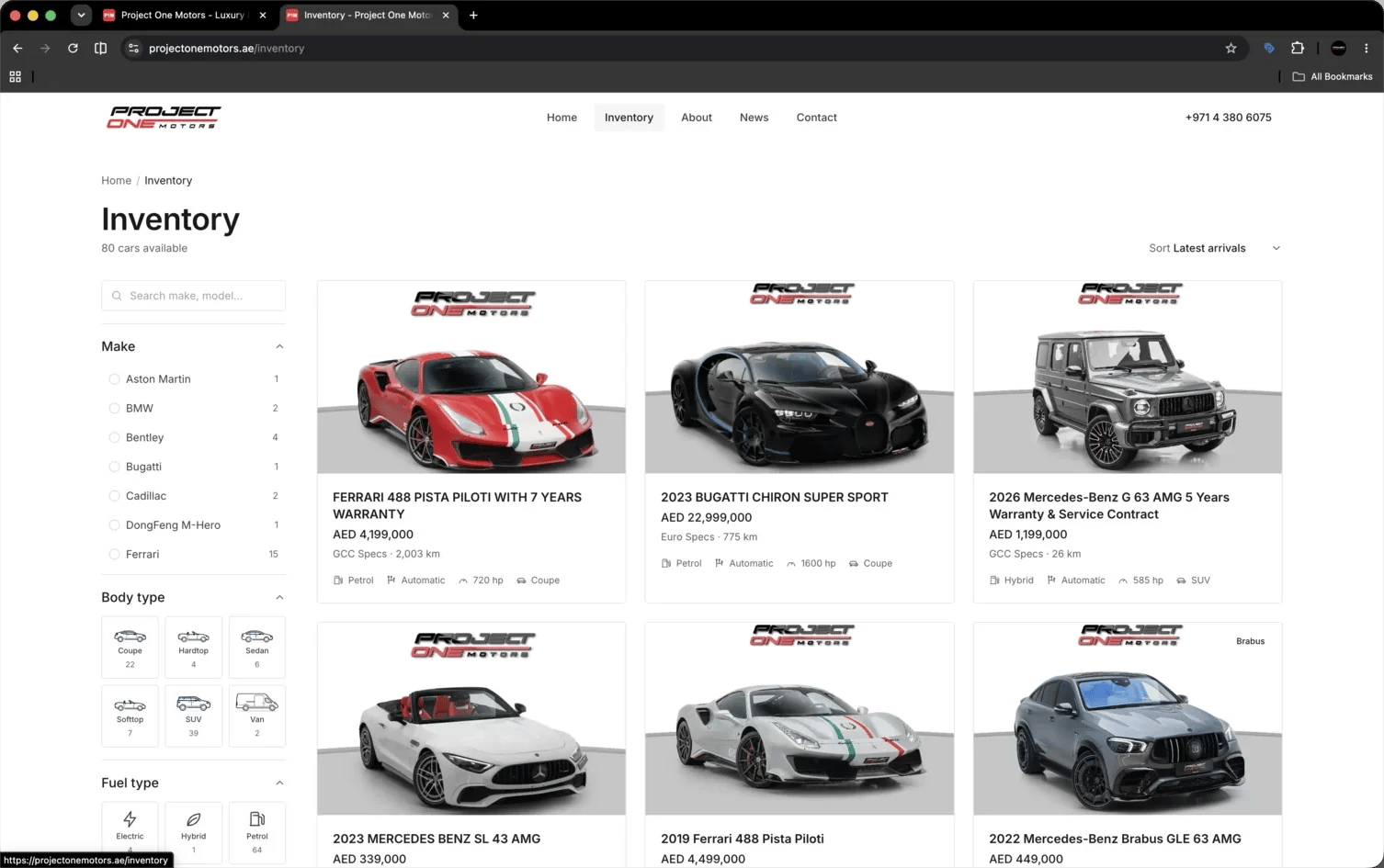
A supercar dealership with a website faster than its cars.
Adding a car went from three places to one.
web · seo · build 2023-2026
websites, automation, digital tools
Three kinds of it, one recipe from each, and a demo that draws the workflow for your own business.
It picks up when you can't - in your voice, from your real prices and your real calendar.
A WhatsApp message arrives at 11pm
AI reads what they're actually asking
Replies with your prices, in your voice
Books the callback in your calendar
Drop a topic or a voice note. It comes back written, waiting for your yes.
You drop a topic into a sheet
AI researches it and checks the sources
Drafts the article in your tone
Waits for your yes before anything publishes
The chases nobody remembers to do, firing whether or not anyone thinks about them.
A job is marked complete
Waits two days, then asks for a Google review
Drafts your reply the moment one lands
Puts the unhappy ones at the top of your list
Two questions, and it draws the workflow.
Which one costs you the most time?
5 of the strongest build case studies.

A messy request in, the right photos out.
automation · ai · build 2024-2026

It logs the car they came for and pings a rep.
product · automation 2026

It tells a buyer from a job hunter, at any hour.
automation · ai · product 2026
Two ways in - a website, or an automation workflow. Every tier and the full scope live on the pricing page.
Lead handling, escalation and follow-up on the channels you already use.
That's the right thing to worry about, so it's the part I build first. The AI drafts a reply and code checks it before it sends: it can only quote prices and details that exist in your own system, and anything it must never discuss is blocked after the model has spoken, not politely requested in a prompt. A reply that trips a rule doesn't go out. A person gets that conversation instead.
They get one. Price negotiation, complaints and anyone who asks for a person are handed straight over, and the moment one of your team starts typing, the bot goes quiet for that customer. It re-checks that right before it sends, because a model takes a few seconds to think and that's long enough for two voices to answer the same person. The handover arrives in your team's own WhatsApp, not a dashboard nobody opens.
Yes - your number, your name on the messages, and nothing for anyone to install. Same for Instagram DMs, the chat on your website and your inbox: it picks up where enquiries already arrive, at 11pm, without you being awake for it.
It's published rather than quoted - an audit, a build, and a monthly run tier, with what's in each one written out. The build buys one clearly bounded workflow, not AI for the whole business, and the scope table says exactly where that boundary sits. Which of the three you need depends on what happens now: who handles the messages, how often, and what it costs you when nobody gets to them. If it isn't worth building, I'll say so.
No, and that's usually what decides whether any of it survives. The sales team I built for never opened a new tool: handovers land in the WhatsApp they already use, and the record of every conversation lives inside the website they already had. Anything that needs a login nobody remembers gets quietly abandoned.
Building it is the short part. The real work is the weeks after it goes live, when real customers do things no plan predicted - the showroom bot replied in the wrong language, offered photos nobody asked for, and answered "ok" with "noted, I'll follow up." Each one became a rule with a test behind it. So it starts on a small allowlist, supervised, before it goes anywhere near a customer.
Yes, and in whatever else your customers turn up speaking. The showroom assistant I run handles Arabic and Russian alongside English, and it files every message twice - the original and an English translation - so whoever's on shift can read a thread in a language they don't speak.
Me. Mayantha Jayasinghe, working on my own out of Dubai. The same person scopes it, writes it, and replies when you email. Nothing is white-labelled from someone else and there's no account manager in the middle, which is the trade: one person's full attention, and one person's calendar.
One person designs it, builds it and keeps it running.
